Web pages move too
We don't always think about it, but web pages move too. Websites, databases and other information systems aren't static: they get built at a particular point in time, with particular expectations, on particular technology. In an ideal world a URL never changes — Cool URIs don't change, as the saying goes. In practice, something always changes: cool URIs don't change, real ones do. Deal with it. (For this post, feel free to read URI and URL as synonyms.)
At Flanders Heritage Agency we've tried, for a long time now (since roughly 2005), to keep our URIs as stable as possible. When a URL has to change or disappear anyway, we set up a redirect from the old URL to a page with the same or similar information. So you can still browse the inventory via https://inventaris.vioe.be, even though https://inventaris.onroerenderfgoed.be has been the canonical URL for years, and https://www.erfgoed.net/beschermingen still sends you to the search form for protected heritage, even though that original page hasn't existed for nearly a decade.
The downside: many people don't realise URLs have changed, and old URLs linger on all kinds of websites, redirecting to newer ones. The longer that goes on, the more tangled the redirect logic gets — old URLs pointing to less-old URLs, which in turn redirect to current ones. Once the memory of those old systems fades, it also gets harder for us to keep everything working. So today we're listing a number of common old links, focused on protected heritage (the inventory itself is covered in a later post).
Information systems for protected heritage
Long before the web was really a thing, there was already a first information system for protected heritage: Melanie, short for Monumenten En LANdschappen InformatiEsysteem. Initially not connected to the internet at all, it later got an online view of the protected objects in a shadow database. Even without URIs, every protected object already got a unique number following a fixed pattern: an O (for "object"), a letter per province (W, O, A, L, B), and six digits between 000000 and 999999 — the Melanie Object Number, such as OO003255 or OW000678. You'll still spot these on today's designation-object records. There were also Melanie Dossier Numbers, structured the same way but starting with D instead of O, since multiple objects could be protected together in one dossier — like DA002378, covering 4 protected monuments by 1 architect.
When Monumenten en Landschappen merged into the Ruimte en Erfgoed agency, its information systems were merged too. Melanie was retired, and its role taken over by Bredero, the case-tracking system already used for Spatial Planning. It also had the concepts of an object and a dossier. A Bredero number has three parts separated by slashes: the document type (protected monument, townscape, protection dossier, ...), a 5-digit NIS code for the municipality or province, and a sequence number. A full number looks like 4.01/43005/162.1 (a protected monument), 4.03/40000/107.1 (a protected landscape), or 4.001/30000/2517.1 (a protection dossier).
When Flanders Heritage Agency was founded in 2011, it quickly became clear that Bredero was well suited to case tracking, but not to a stable environment for detailed, object-related heritage information. The existing Flanders Heritage Inventory offered far more there, and that synergy produced the designation objects (see Heritage objects and designation objects). When building that dataset, we carried over the old identifiers as much as possible, which is why a designation object's page still lists older numbers today under Beschermingsdossiers. The inventory itself had always lived on the web and always used URIs, and since designation objects came about, we've followed the Flemish Government's URI guidelines. So you can find the parish church of St. Peter and St. Paul in Hansbeke under the old Melanie number OO001175, the equivalent Bredero number 4.01/44049/119.1, and the new URI https://id.erfgoed.net/aanduidingsobjecten/10535.
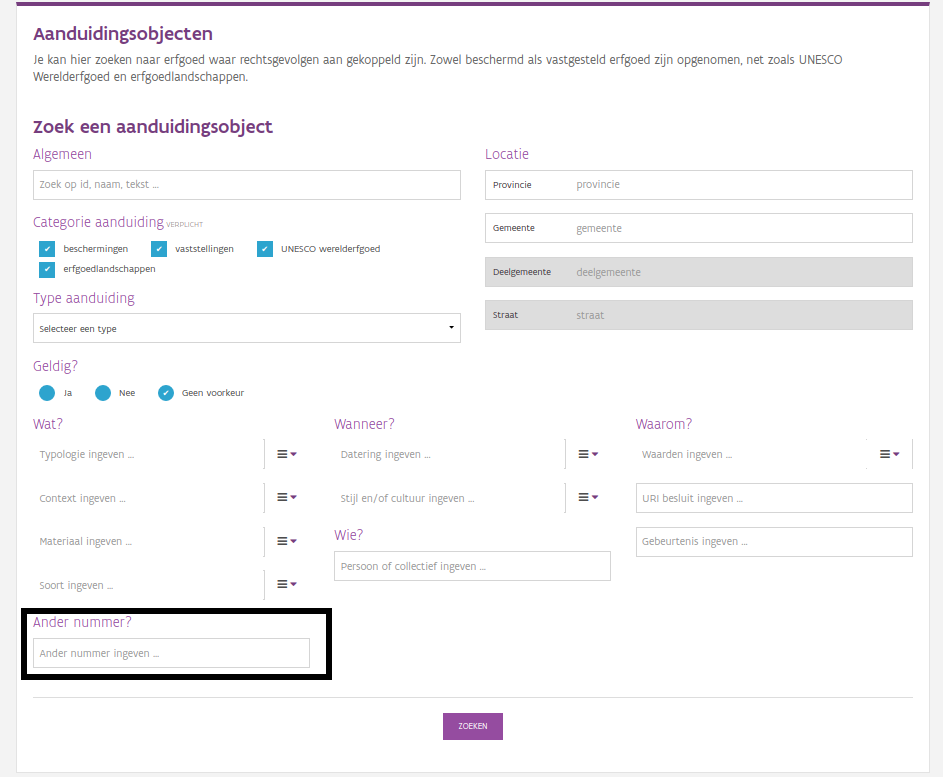
Searching by Melanie or Bredero number on the designation objects search form
The protection-database project included migrating protected objects from Bredero into designation objects, with close attention to data quality, a re-evaluation of old data, and the addition of new information such as location data and thesaurus terms. Sometimes an old Melanie or Bredero number had to be split across several new records, so today one old number can occasionally map to more than one record — the exception rather than the rule. To make this easy, you can just search on an old number: go to the designation objects search form and enter the Melanie or Bredero number under Ander nummer? ("other number?") at the bottom.
Old URLs
If you still have an old URL lying around somewhere, it will always contain a Melanie or Bredero number. URLs from 2012–2016 probably look like https://beschermingen.onroerenderfgoed.be/object/id/OO001175 or https://beschermingen.onroerenderfgoed.be/object/id/4.01/44049/119.1. After 2016 that traffic was redirected to an inventory page such as https://inventaris.onroerenderfgoed.be/erfgoed/beschermd/OO001175, showing every linked designation object (or redirecting straight through if there was only one). Today that traffic goes to something like https://inventaris.onroerenderfgoed.be/aanduidingsobjecten?ander_nummer=OO001175, showing every designation object matching that old number.
If you have even older URLs like http://paola.erfgoed.net/engine/fiche.php?id=000816&pv=O, those no longer work, but you can easily reconstruct the Melanie number: take the value of pv, followed by O, followed by the value of id — giving OO000816, which you can then look up under "other number" in the new inventory. That eventually leads you to the Motte de Hoge Wal in Ertvelde.
If you have old links, we strongly recommend converting them to our new URIs. Note the distinction between the document URI (say, the page you can read about the Hoge Wal) and the concept URI (representing the concept of the Hoge Wal as a tangible object). We only guarantee persistence on the latter: the document URI is tied to our domain name onroerenderfgoed.be, which is tied to our organisation's name, while the concept URIs on erfgoed.net aren't affected by that.
Say it with a script
If you have a lot of links to our site, looking them up one by one is a lot of work. So we've put together a short Python script that resolves a whole batch of old Melanie or Bredero numbers to their URIs in one go: save the script, provide a CSV file listing the old identifiers, and run it. The full script is available in this blog's source repository on GitHub.