Heritage objects and designation objects
On May 13 we launched a brand new Flanders Heritage Inventory. Anyone who has used it will have noticed five datasets: heritage objects (erfgoedobjecten), designation objects (aanduidingsobjecten), people, themes and events. Heritage and designation objects form the core of the inventory database; the other three datasets are covered in a later post.
Heritage objects are the beating heart of the inventory: the things we and you consider heritage, from Antwerp Cathedral or the Gravensteen to the Zwin nature reserve, a chapel, a tree, a ship or an organ. The focus isn't on legal consequences but on the scientific record: what is it, how big, where, how old, what does it look like, who was involved, where can I learn more? A heritage object's boundary is often a bit fuzzy in practice — for the Gravensteen, one person might see only the keep, another might include the moat, and a third might count the adjoining square as well. We settle on one boundary per object without treating it as perfectly exact.
Designation objects, by contrast, are heritage as it's legally anchored: the protection or listing of a heritage object. Where a heritage object's boundary can be a bit vague, a designation object's must be beyond dispute, since it determines which legal consequences apply to a given piece of Flanders. Since the new Immovable Heritage Decree, we now delineate listed heritage with a polygon rather than points. The key questions for a designation object: exactly how large is it, what type of designation is it, why does it have heritage value, and which decree or document backs that decision? A single heritage object can be anchored more than once, under different statuses.
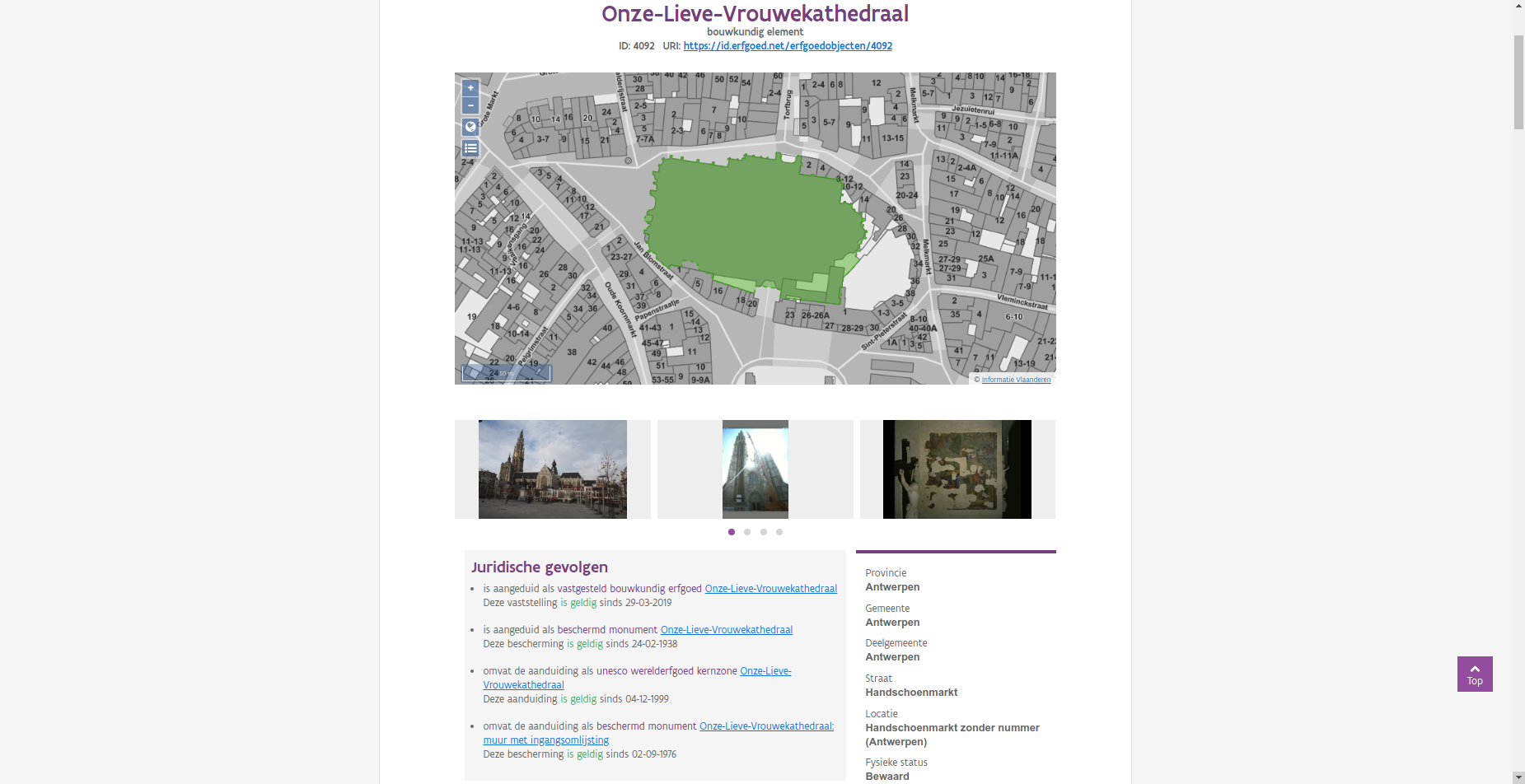
Antwerp Cathedral, a heritage object and its designations
Look at Antwerp Cathedral, for instance, and you'll find four designations: a listing as built heritage, a designation as UNESCO World Heritage, a protection as a monument, and an additional protection of a section of wall, also as a monument. The heritage object "the cathedral" tells you what it is; the designation objects tell you, in detail, what applies to its various parts.
Couldn't this be simpler?
At first glance, this split looks complex and arbitrary. It emerged during the protection-database project, shortly after the merger of the Ruimte en Erfgoed agency and the Flemish Institute for Immovable Heritage. The first managed the protection database, the second the inventory database, which at the time consisted of several separate inventories (built heritage, gardens and parks, woody plantings, ...), each with its own record per element.
Because the protection database offered far less functionality than the inventory database at the time, all protected heritage was added into the inventory database, immediately equipped with images, thesaurus terms and extended descriptions. In that first data model, protected heritage was described identically to inventoried heritage: a record for a church in the built-heritage inventory, a separate record for that same church as a protected monument, and possibly yet another record as part of a village townscape. Those records largely repeated the same content, sometimes with slight differences due to a different boundary — a nightmare to maintain whenever new insight about a building came to light.
A similar problem existed between the different inventories themselves. When they were still published on paper (in series like M&L Cahiers and Bouwen door de Eeuwen Heen), overlap between, say, a historic garden and its associated built heritage was manageable; online, this proved less straightforward, sometimes leading to contradictory records.
Eventually we changed course by strictly separating two things. On one hand, the content: we now assign every heritage object one or more disciplines (archaeological, architectural, landscape, or maritime), and bring as much information as possible together into a single record, regardless of which part of it is protected. On the other hand, the legal information, which we want to be able to handle independently — a protection can cease to exist, for example, without the heritage itself disappearing. That's how we reworked the protection database into a database of designation objects, a term we borrowed from Historic England, where "designation" refers to the formal act of attaching legal consequences to heritage.
Everything is connected
Our heritage is vast and varied, and every record puts just a small piece of reality in the spotlight — pieces that are connected to each other. That's why we've been linking objects with relations for about a decade. Where heritage used to be managed mostly as isolated points, there's been a long-running shift toward larger wholes and contexts that matter just as much as the small elements we readily recognise as heritage. Former built ensembles, archaeological zones and anchor points have all become heritage objects, with a consistent distinction between ensembles (larger areas) and elements (smaller-scale pieces of heritage). Since 2009, we've linked heritage objects using three relations:
- is related to: a connection between two objects, without one containing the other — for example a coal mine and a miners' housing estate.
- contains: one heritage object contains another, such as a castle estate containing the coach house, or a church containing a separately described organ.
- is part of: the inverse of "contains" — the organ is part of the church, the coach house part of the estate.
For the interaction between heritage objects and designation objects, we distinguish three relations:
- is designated as: the heritage object and the designation object are (nearly) identical in extent — the heritage object is (roughly) fully protected or listed.
- encompasses the designation as: the heritage object is larger than the designation object, e.g. a church of which only the tower is protected.
- is part of the designation as: the heritage object is smaller than the designation object, e.g. an individual tree within a protected landscape.
Help, I'm looking for something!
So when do you use which dataset? You can search heritage objects or search designation objects, and both forms offer filters related to legal consequences. With heritage objects, you're primarily searching on content characteristics — the unit of information is heritage. With designation objects, you're searching on characteristics of the designation itself — the unit of information is a legal decision about heritage.
Search for protected libraries, for example, and typologie=bibliotheken + rechtsgevolgen=beschermd on heritage objects gives 17 results, while typologie=bibliotheken + categorie=beschermingen + geldig=true on designation objects gives 22 results — not quite the same thing. The first is 17 heritage objects that are (partly) a library and carry a protection; the second is 22 protected objects that relate to a library in some way. The Loppem Castle estate, for instance, is protected twice: the whole estate as a landscape, and the manor house with outbuildings separately as a monument.
Splitting our information into heritage objects and designation objects lets us handle content flexibly and make additions without touching the legally anchored data. Got suggestions for making our information clearer? Get in touch.